
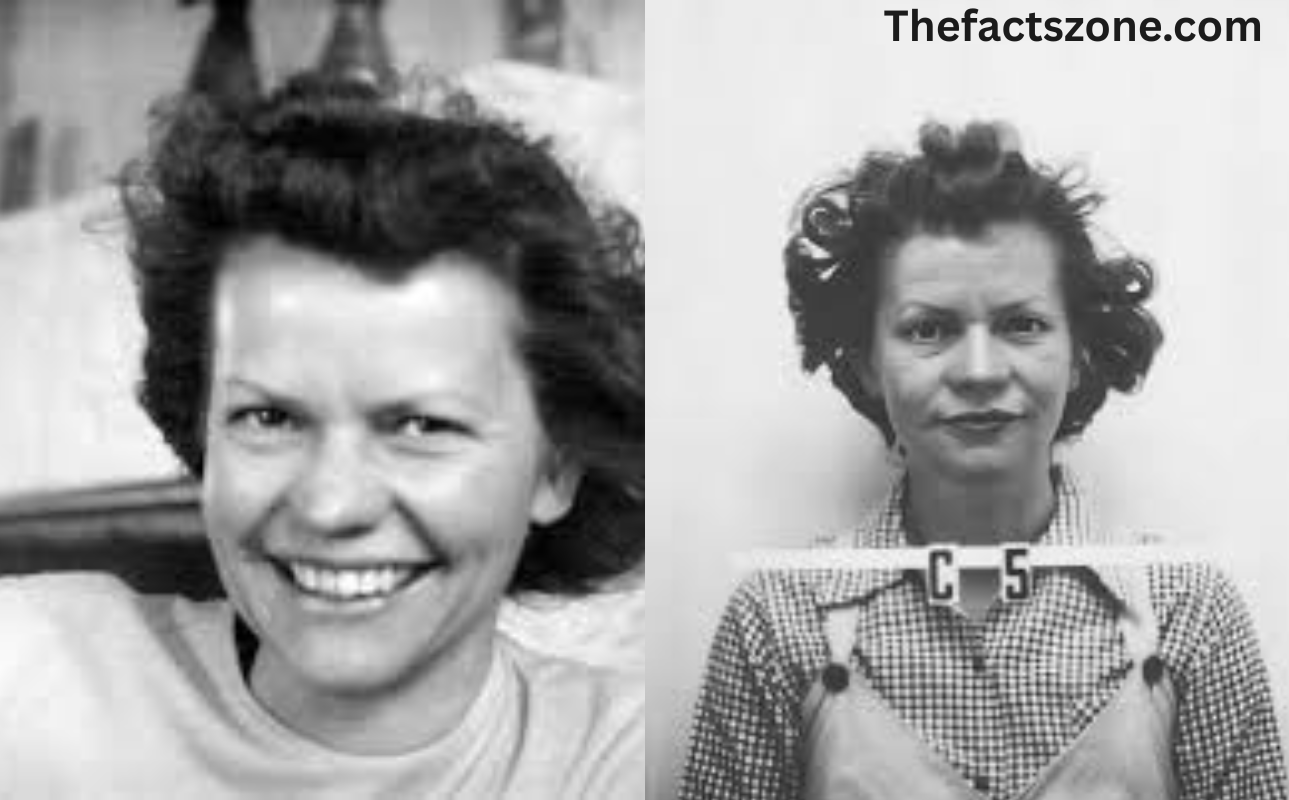
History often remembers famous men, but behind many of them stood women whose stories were equally powerful, complex, and unforgettable. Katherine Oppenheimer, widely known as Kitty Oppenheimer, was one of those women. While many people recognize her as the wife of physicist J. Robert Oppenheimer, the scientific director of the Manhattan Project, Kitty’s own life was filled with intelligence, courage, struggle, and remarkable personal transformation.
Table of Contents
ToggleShe was not simply the woman standing beside one of the most important scientists of the twentieth century. She was a trained botanist, a biologist, a woman deeply involved in academic life, and someone who experienced political activism, personal heartbreak, and immense public scrutiny. Her life stretched across Germany, America, wartime Los Alamos, Princeton society, and the Caribbean coast, carrying with it both glamour and emotional turbulence.
Katherine Oppenheimer remains one of the most fascinating figures connected to modern scientific history because she lived at the center of global change. From her early education and scientific work to her role during the development of the atomic bomb, her life reflected both brilliance and contradiction. Her journey reminds us that history is not made by one person alone—it is shaped by the people beside them, supporting, challenging, and influencing every major decision.
Katherine Oppenheimer Quick Facts Table
| Fact | Details |
|---|---|
| Full Name | Katherine Vissering Oppenheimer |
| Popular Name | Kitty Oppenheimer |
| Birth Name | Katherine Vissering Puening |
| Date of Birth | August 8, 1910 |
| Age at Death | 62 years |
| Birthplace | Recklinghausen, Germany |
| Nationality | German-American |
| Profession | Botanist, Biologist |
| Famous For | Wife of J. Robert Oppenheimer, Manhattan Project connection |
| Father | Franz Puening |
| Mother | Käthe Vissering |
| Siblings | Only child |
| Spouse | J. Robert Oppenheimer |
| Children | Peter Oppenheimer, Katherine “Toni” Oppenheimer |
| Education | University of Pittsburgh, University of Pennsylvania |
| Political Background | Former Communist Party member |
| Estimated Net Worth | Historical records do not provide exact figures |
| Not applicable | |
| Twitter/X | Not applicable |
| Not applicable | |
| Date of Death | October 27, 1972 |
| Place of Death | Panama City, Panama |
Kitty Oppenheimer was born in Recklinghausen, Germany, on August 8, 1910, and moved to the United States as a child. She later became known as a German-American botanist and biologist, earning a degree in botany from the University of Pennsylvania and becoming closely associated with the Manhattan Project years through her marriage to Robert Oppenheimer.
Early Life and Family Background
Katherine Vissering Puening was born into a well-educated and socially comfortable family. Her father, Franz Puening, was a metallurgical engineer who built a strong professional career in the steel industry after the family moved to the United States. Her mother, Käthe Vissering, came from a respected European background, and family pride in heritage was something Kitty carried throughout her life. She was their only child, which meant she received both attention and high expectations from an early age.
Although she was born in Germany, her family immigrated to America when she was just two years old and settled in the Pittsburgh area, particularly in Aspinwall, Pennsylvania. She grew up speaking both German and English fluently, and her parents regularly took her back to Germany during summers. This international upbringing gave her a strong sense of confidence and sophistication that would later define her personality in elite academic and scientific circles.
From a young age, Kitty was known for being strong-minded, stylish, and intellectually curious. She loved horseback riding, outdoor adventure, and challenging conversations. She was not interested in living a quiet, conventional life. Even in her teenage years, people around her noticed that she had a sharp mind and an independent spirit that refused to be limited by traditional expectations placed on women of that era.
Education and Scientific Interests
Education became one of the strongest foundations of Kitty Oppenheimer’s identity. After graduating from high school in 1928, she enrolled at the University of Pittsburgh, where she studied mathematics, biology, and chemistry. These subjects reflected her natural curiosity and analytical mind. She was drawn toward science not as a social accessory, but as a genuine academic interest.
Her educational path was not entirely smooth. Like many ambitious young people of her generation, she moved between universities and countries while trying to define her future. She spent time in Europe, briefly attended academic institutions there, and later returned to complete her studies in the United States. Eventually, she pursued botany seriously and earned her Bachelor of Science degree from the University of Pennsylvania with honors in 1939.
Choosing botany and biology was significant because women in science during that period often faced social and institutional barriers. Kitty’s scientific training gave her credibility and independence. She was not simply married to science—she belonged to it. Her work in biology later connected naturally to the scientific world of Los Alamos during World War II, where her education became practically valuable.
Early Relationships and Personal Struggles
Before marrying Robert Oppenheimer, Kitty had already lived a life full of emotional intensity and personal reinvention. She had several marriages before meeting him, and each chapter reflected both her restless personality and the politically charged environment of the 1930s. Her first marriage to Frank Ramseyer, a musician, was brief and ended quickly.
Her second major relationship was with Joe Dallet, a committed Communist organizer. This relationship deeply shaped her worldview. She became involved in Communist Party activities and was active in labor and political organizing. Dallet later left to fight in the Spanish Civil War and was killed in battle in 1937. His death left a lasting emotional mark on Kitty and changed the direction of her life.
Later, she married British doctor Richard Harrison while continuing her academic studies. But her life changed dramatically when she met Robert Oppenheimer at a garden party in California in 1939. Their attraction was immediate and impossible to ignore. Soon, she divorced Harrison and married Robert in November 1940, beginning the chapter for which history would remember her most.
Marriage to J. Robert Oppenheimer
Kitty’s marriage to J. Robert Oppenheimer placed her at the center of scientific and political history. Robert was brilliant, emotionally intense, and often absorbed by his work, while Kitty was direct, confident, and fiercely independent. Their personalities were different, but they created a powerful partnership built on intellectual respect and emotional dependence.
They married in November 1940, and their first son, Peter, was born the following year. Their relationship was passionate, but not always easy. Both were strong personalities, and both struggled with emotional pressure and the demands of public life. Yet Robert trusted Kitty deeply. He often treated her not just as a wife, but as one of his closest confidantes.
As Robert’s career accelerated during World War II, Kitty found herself pulled into a world of secrecy, national security, and extraordinary responsibility. Their marriage became part of a much larger historical story, and she had to learn how to balance motherhood, science, politics, and emotional survival all at once.
Life at Los Alamos During the Manhattan Project
When Robert became director of the secret Los Alamos Laboratory for the Manhattan Project, Kitty moved with him to New Mexico. Life there was unlike anything ordinary families experienced. The entire community lived under strict secrecy while scientists worked on the development of the atomic bomb. Isolation, pressure, and uncertainty shaped daily life.
Kitty did not remain only in the background. She used her biology training and worked as a laboratory technician under Dr. Louis Hempelmann, helping conduct blood tests related to radiation exposure and health safety. Although she worked there for about a year, the professional limitations frustrated her because she wanted deeper scientific involvement.
She also became socially important within Los Alamos. Kitty hosted gatherings, cocktail evenings, and informal support spaces for families living under wartime stress. These social moments mattered. They created emotional relief in a place dominated by fear, deadlines, and secrecy. Her presence helped shape not only the household of Robert Oppenheimer, but the social life of the entire scientific community.
Personal Life, Character, and Public Image
Kitty Oppenheimer was often described as elegant, intense, and unforgettable. Some admired her beauty and intelligence, while others found her intimidating. She had little patience for superficial behavior and preferred directness over politeness. In many ways, she challenged the expectations society had for women in powerful circles.
She loved horseback riding, sailing, literature, orchids, and long intellectual conversations. In Princeton, Robert even built her a greenhouse where she raised orchids, and for birthdays he reportedly arranged rare species to be flown in from Hawaii. These details showed both her refined taste and the affection that still existed in their complicated marriage.
At the same time, Kitty faced personal struggles, especially with alcohol and health issues such as pancreatitis. Public life, political investigations, and emotional pressure took a toll on her well-being. Her story was never simple. She was brilliant and difficult, loyal and wounded, admired and criticized—all at once.
Children and Family Life
Kitty and Robert had two children: Peter Oppenheimer and Katherine “Toni” Oppenheimer. Peter was born in 1941, and Toni was born in Los Alamos in 1944 during the Manhattan Project years. Raising children in such an unusual environment was emotionally demanding and far from normal family life.
Security restrictions, wartime secrecy, and Robert’s long hours meant Kitty often carried the heavier emotional burden of family life. She had to protect normal childhood experiences inside an environment shaped by national secrets and global fear. Like many women around her, she managed domestic stability while history unfolded outside the front door.
Her children would later live under the weight of the Oppenheimer name, which brought both privilege and pressure. Family life was not always peaceful, but Kitty remained deeply connected to her role as a mother, even while navigating the emotional storms of public life.
Net Worth and Financial Life
Unlike modern public figures, Katherine Oppenheimer’s financial life was never measured through celebrity wealth or public brand deals. Her lifestyle was shaped by academic prestige, inheritance, and Robert Oppenheimer’s professional success. The family lived comfortably, particularly during their Princeton years at the Institute for Advanced Study.
Their home life reflected upper-class intellectual stability rather than luxury entertainment wealth. They later built a beach house on St. John in the Virgin Islands, where the family spent summers sailing and escaping public pressure. These choices reflected privilege, but also a desire for privacy and peace rather than status.
Because detailed financial records are limited, no exact net worth estimate exists for Kitty Oppenheimer. However, historians generally place the family within a financially secure upper-class lifestyle. Their true legacy was never measured in money—it was measured in history, science, and cultural impact.
Legacy, Final Years, and Lasting Influence
After Robert Oppenheimer died of throat cancer in 1967, Kitty entered one of the most difficult periods of her life. Their marriage had been complex, but it was also central to her identity. She had spent decades standing beside one of the world’s most famous scientists, and his death left a deep emotional silence.
She remained connected to Robert Serber, a longtime family friend and physicist from the Manhattan Project years. Together, they spent time sailing and planning long sea journeys. Kitty found peace near the ocean, especially around St. John in the Virgin Islands, where Robert’s ashes had been scattered after his death.
In 1972, while preparing for further travel by sea, Kitty died in Panama City, Panama, from a pulmonary embolism at the age of 62. Her ashes, like Robert’s, were connected to the waters near their beloved island retreat. Her life ended quietly, but her legacy never disappeared. She remains one of the most compelling women connected to twentieth-century scientific history.
Conclusion
Katherine Oppenheimer was far more than the wife of a famous physicist. She was a scientist, a thinker, a survivor, and a woman whose life reflected both extraordinary privilege and deep personal struggle. Her journey moved across continents, political movements, academic spaces, and one of the most important scientific moments in human history.
She reminds us that behind historic events are human beings with fears, flaws, intelligence, and emotional strength. Kitty lived with contradiction and courage. She was strong without being simple, brilliant without being easy to define, and unforgettable because she was fully human.
As Katherine Oppenheimer paved the way for greater recognition of women behind historic scientific movements, her story stands as a reminder of how resilience and purpose can shape a meaningful legacy. Her life encourages us to look beyond headlines and remember the people whose quiet strength changed history from within.